DIMACERI AIoT Framework Explained
Artificial Intelligence (AI) and the Internet of Things (IoT) are reshaping how industries operate. Together, they form the Artificial Intelligence of Things (AIoT), an ecosystem where intelligent systems transform vast streams of sensor data into actionable insights, autonomous decisions, and optimized operations. In this article, the DIMACERI AIoT framework is introduced as a holistic approach to building trustworthy AIoT systems that integrate intelligence across multiple dimensions of the ecosystem.
From predictive maintenance in manufacturing to intelligent traffic management in smart cities, AIoT has demonstrated enormous potential. Yet, despite these advances, one challenge remains consistent across industries: AIoT systems are often developed in fragments. Such like;
Researchers solve cybersecurity challenges. Engineers optimize communication networks. Data scientists build predictive models. Cloud architects improve scalability.
Each discipline contributes valuable innovations, yet they frequently address individual problems rather than considering the AIoT ecosystem as a whole. This realization became the foundation of DIMACERI Framework.
Why DIMACERI Was Created
DIMACERI originated during a semi-systematic literature review exploring the role of Artificial Intelligence in Internet of Things systems. While reviewing research across healthcare, manufacturing, agriculture, cybersecurity, smart cities, transportation, and environmental monitoring, one pattern became increasingly apparent. Most studies focused on solving one challenge at a time.
Security was treated separately from interoperability. Automation was studied independently from governance. Predictive analytics rarely considered sustainability. Scalability was discussed without addressing trust.
Although these individual solutions advanced their respective fields, few attempted to understand how Artificial Intelligence could simultaneously strengthen the entire AIoT ecosystem. DIMACERI was therefore proposed as a conceptual framework that views AIoT through multiple interconnected dimensions rather than isolated technical problems.
Instead of asking,“How can AI solve this problem?” ……DIMACERI asks, “How can AI strengthen the entire system?”
What is this Framework?
Well, DIMACERI is a holistic framework that identifies the critical dimensions influencing trustworthy AIoT systems and provides a structured approach for integrating Artificial Intelligence across them.
Rather than functioning as another machine learning algorithm, programming framework, or communication protocol, DIMACERI acts as a conceptual orchestration framework.
Its purpose is to help researchers, engineers, architects, and organizations understand where intelligence should be embedded, how different AI capabilities interact, and how technical decisions influence the broader AIoT ecosystem.
The framework recognizes that every AIoT deployment is multidimensional. Figure this, A predictive maintenance model may improve equipment uptime, but if cybersecurity is weak, the system remains vulnerable. Or, An autonomous decision system may increase efficiency, but without explainability, trust quickly deteriorates. Or, this too, Scalable cloud infrastructure becomes less valuable if heterogeneous devices cannot communicate effectively.
DIMACERI therefore promotes systems thinking rather than isolated optimization.
The Philosophy Behind DIMACERI
At its core, DIMACERI Framework is built upon one principle; Intelligent systems should be designed as interconnected ecosystems rather than collections of independent technologies.
Artificial Intelligence should not exist as a standalone component that performs prediction after data has already been collected.
Instead, AI should become an intelligent layer operating throughout the entire lifecycle of an AIoT system.
This means intelligence is embedded within sensing, communication, computation, orchestration, automation, governance, and decision-making.
Rather than optimizing one component, DIMACERI encourages developers to optimize relationships between components.
The Eight Dimensions of DIMACERI
The framework consists of eight complementary dimensions representing the primary challenges found across modern AIoT environments. These dimensions do not operate independently, but instead, continuously influence one another.
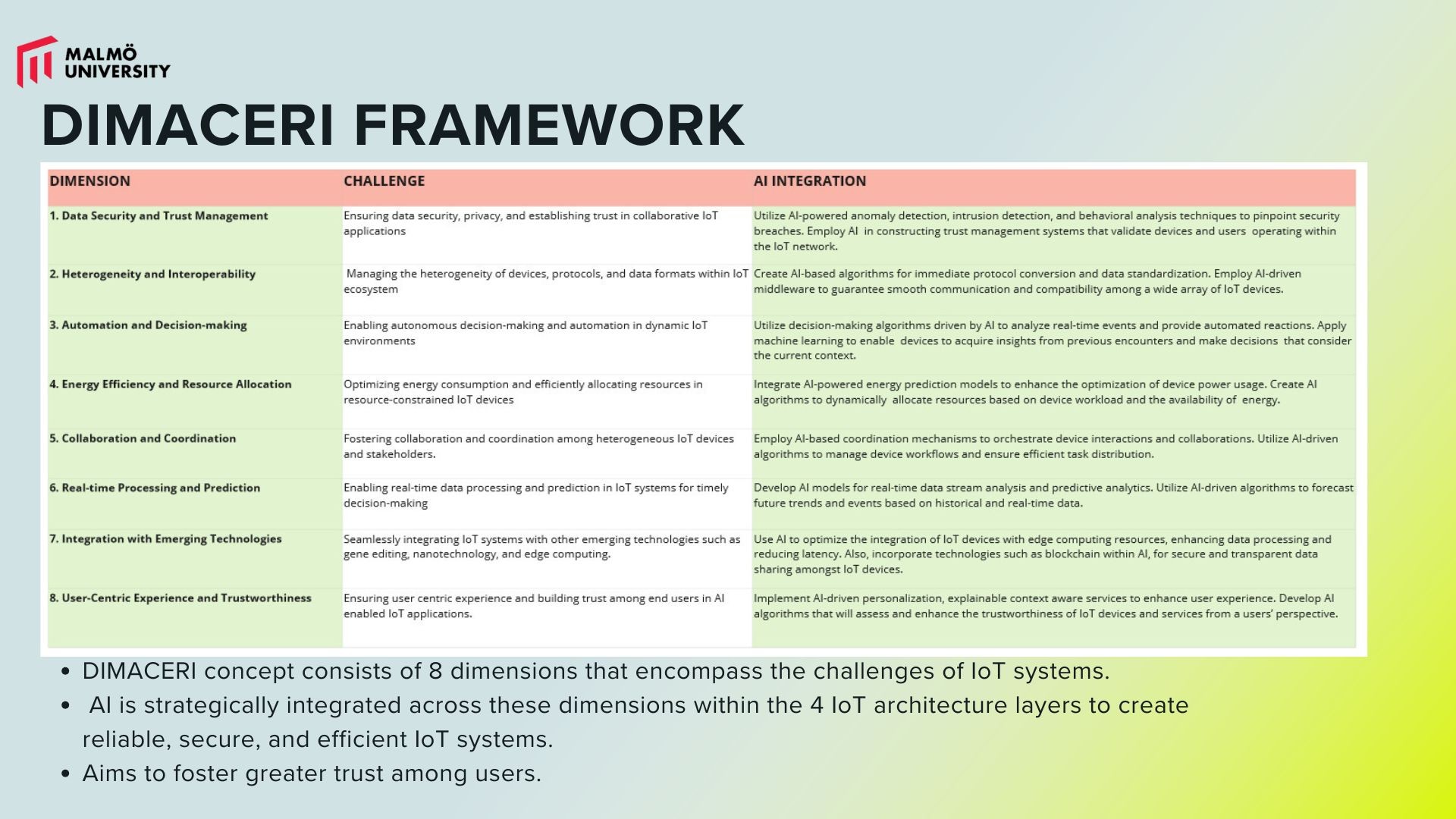
D – Data Security and Trust Management
Concept, Every AI system depends on trustworthy data.
This dimension focuses on protecting information throughout its lifecycle by ensuring confidentiality, integrity, authentication, authorization, secure communication, and privacy preservation.
Artificial Intelligence strengthens this dimension through anomaly detection, intelligent intrusion detection, adaptive authentication, and continuous threat monitoring. Trustworthy data forms the foundation upon which every intelligent decision is built.
I – Integration with Emerging Technologies
AIoT systems rarely rely on a single technology.
Modern deployments combine Artificial Intelligence with cloud computing, edge computing, digital twins, blockchain, 5G, and increasingly, distributed AI infrastructures. This dimension explores how these technologies can complement one another rather than compete for resources. AI becomes the coordinating intelligence that enables seamless integration across heterogeneous technological environments.
M – Multidimensional AI Integration
Many organizations deploy AI only at the application level. DIMACERI proposes a broader perspective.
Artificial Intelligence should support every layer of an AIoT architecture—from sensing and communication to analytics, prediction, orchestration, and autonomous decision support. Rather than isolated machine learning models, intelligence becomes a distributed capability throughout the entire system.
A – Automation and Decision-Making
Automation is one of AI’s greatest strengths.
However, automation without accountability introduces significant technical and ethical risks. This dimension emphasizes explainable, transparent, and responsible AI capable of supporting human decision-makers while maintaining governance, compliance, and oversight. The goal is not replacing humans but augmenting human intelligence.
C – Collaboration and Coordination
Future AIoT systems will involve millions of connected devices, software services, intelligent agents, robots, and people.
Managing these complex interactions requires more than connectivity. It requires coordination. Artificial Intelligence enables intelligent collaboration through adaptive communication, distributed decision-making, resource sharing, and dynamic orchestration across devices and organizational boundaries.
E – Energy Efficiency and Resource Optimization
As AI models become increasingly sophisticated, computational efficiency becomes equally important.
DIMACERI recognizes sustainability as a strategic objective. Artificial Intelligence can optimize computing resources, balance workloads between cloud and edge environments, minimize energy consumption, extend hardware lifespan, and reduce operational costs while maintaining system performance.
R – Real-Time Processing and Prediction
Modern AIoT systems generate enormous volumes of data every second.
Extracting value requires more than storing information. It requires understanding events as they happen. Artificial Intelligence enables predictive maintenance, anomaly detection, forecasting, adaptive control, and intelligent decision support in real time, allowing organizations to shift from reactive operations toward proactive management.
I – Interoperability and Heterogeneity
Perhaps the greatest challenge facing AIoT is diversity.
Devices originate from different manufacturers. Communication protocols differ. Data formats vary. Computing capabilities range from low-power sensors to cloud supercomputers. DIMACERI treats interoperability as a fundamental requirement. Artificial Intelligence helps bridge these heterogeneous environments through intelligent translation, adaptive integration, semantic understanding, and user-centered system customization.
Why the Dimensions Matter
The true strength of DIMACERI lies not in the individual dimensions but in their interdependence. Look at this……..
Improving cybersecurity without interoperability still limits deployment.
Enhancing automation without explainability reduces trust.
Optimizing prediction without high-quality data decreases reliability.
Reducing energy consumption without maintaining real-time responsiveness compromises operational performance.
Each dimension continuously influences the others.
DIMACERI therefore encourages organizations to move away from solving isolated technical challenges and instead develop AIoT ecosystems where intelligence, security, sustainability, governance, and trust evolve together.
DIMACERI’s Role Within AIoT Systems
Rather than replacing existing architectures, DIMACERI acts as an orchestration framework. Its role is to determine where Artificial Intelligence creates the greatest value throughout an AIoT system. Within the perception layer, AI validates sensor quality, detects abnormal behavior, filters noisy data, and improves data reliability. Within communication networks, AI optimizes routing, detects cyber threats, manages bandwidth, and improves resilience. At the edge and cloud layers, AI balances workloads, performs predictive analytics, synchronizes digital twins, and enables low-latency decision-making.
Finally, at the application layer, AI supports predictive maintenance, operational optimization, autonomous decision-making, and human-centered decision support. Rather than existing as isolated algorithms, Artificial Intelligence becomes the coordinating intelligence spanning every layer of the AIoT ecosystem.
Industrial AIoT: Where DIMACERI Creates Value
Industrial environments represent one of the strongest applications of the framework.
Factories generate millions of sensor readings daily, and machines continuously communicate with one another. Energy consumption must be optimized, and mostly production schedules constantly change. With these, cybersecurity threats evolve and maintenance windows are limited.
DIMACERI enables Artificial Intelligence to coordinate these interconnected processes. Instead of monitoring individual machines independently, AI continuously evaluates relationships between production equipment, communication networks, maintenance schedules, cybersecurity events, digital twins, energy consumption, and operational objectives. The result is an Industrial AIoT ecosystem capable of learning, adapting, and optimizing itself while maintaining human oversight.
Beyond the Thesis: The Future of DIMACERI
The current DIMACERI framework represents the beginning of a broader research vision rather than its conclusion.
As Artificial Intelligence evolves beyond prediction and automation toward autonomous reasoning and intelligent collaboration, AIoT systems will require more than increasingly powerful machine learning models. They will require architectures capable of orchestrating intelligence across entire ecosystems. My long-term vision is for DIMACERI to evolve into a reference architecture for trustworthy AIoT systems. Rather than competing with existing standards or enterprise architectures, DIMACERI would complement them by providing a structured approach to integrating Artificial Intelligence across technical, operational, organizational, and governance dimensions. Future iterations of the framework may incorporate emerging technologies such as federated learning, explainable AI (XAI), agentic AI, digital twins, knowledge graphs, edge intelligence, and multi-agent systems.
These capabilities could enable AIoT ecosystems that are increasingly adaptive, collaborative, resilient, and self-organizing while preserving transparency, security, and human oversight. Ultimately, the goal of DIMACERI is not to create another Artificial Intelligence model. It is to provide a framework for designing intelligent systems that are trustworthy by design. Because the future of AI will not be defined solely by how intelligent individual algorithms become. It will be defined by how intelligently entire systems collaborate.
Final Thoughts
Artificial Intelligence is transforming how connected systems perceive, learn, and act. Yet intelligence alone is not enough. The next generation of AIoT systems must also be secure, interoperable, explainable, sustainable, resilient, and worthy of trust.
DIMACERI was born from the observation that these qualities cannot be treated as separate engineering challenges. They are interconnected dimensions of the same ecosystem.
By encouraging holistic thinking and strategic AI integration, DIMACERI offers a vision for AIoT that goes beyond isolated algorithms. It proposes a future where Artificial Intelligence is not merely a tool embedded within connected devices, but the coordinating intelligence that enables entire ecosystems to collaborate, adapt, and evolve responsibly.
As AI continues to reshape industries, the need for frameworks that unite technical excellence with trust, governance, and systems thinking will only grow. DIMACERI is one step toward that future.